


You get three quotes for the same office fit-out. One says IDR 3 million per square meter. Another says 6 million. The third comes in at 11 million. Same floor plan, same brief, triple the price range.
This confuses people, but the gaps aren't random. Each number reflects a different set of assumptions about what's included, how the work gets done, and what level of risk the firm is absorbing on your behalf. Once you understand what's actually driving the difference, you can stop comparing numbers and start comparing value.
The Basics: What Goes Into a Quote
How Firms Bundle Their Services
Interior design-build pricing has three main components: design work, construction execution, and materials. The way a firm packages these changes what you see on the proposal.
Some firms separate design fees from construction. You pay IDR 25-50 million for design services, then get a separate construction quote once drawings are finalized. Others roll everything into a single per-square-meter rate. Bundled pricing is simpler to read, but it hides how your money is allocated. You can't tell if you're paying more for design quality, better materials, or just higher overhead.
A third model charges design fees upfront, then marks up materials and labor during construction. The markup typically ranges from 15-35%. That covers sourcing time, logistics coordination, quality checks, and the risk of things arriving damaged or wrong.
Overhead Is Real and It Varies Wildly
A solo designer working from a home office might carry IDR 15-20 million per month in fixed costs. Software subscriptions, a phone, maybe a part-time assistant.
A firm with a proper studio, a project management team, site supervisors, and procurement staff? Their monthly overhead can easily hit IDR 200-300 million before they start a single project.
That overhead gap shows up directly in your quote. The solo designer can charge less per square meter because they have less to cover. The question is whether the firm's higher overhead translates into better execution. If it means dedicated project managers, real site supervision, and someone actually checking material quality before installation, then you're getting something for the premium. If it just means a fancier office and more admin staff, you're subsidizing their lifestyle.
Experience Changes the Math
A designer five years into their career is still learning which materials survive Jakarta's humidity, which suppliers actually deliver on time, and how long MEP coordination really takes. They'll get there eventually, but they're learning on your project.
A team that's done 700+ projects already knows that SPC flooring warps in tropical humidity no matter what the supplier claims. They know a 4-meter tempered glass panel won't fit through most building service lifts. They know that specifying European timber for an exterior facade in Jakarta means you'll be replacing it within a year.
That pattern recognition prevents expensive mistakes. When a senior practitioner looks at your floor plan and immediately asks about service lift dimensions and crane access, they're saving you from discovering those constraints during construction when it costs 5x more to fix.
You're not paying for fancier taste. You're paying for someone who already made the mistakes you haven't thought of yet.
Where the Real Price Gaps Come From
Material Specifications (The Biggest Variable)
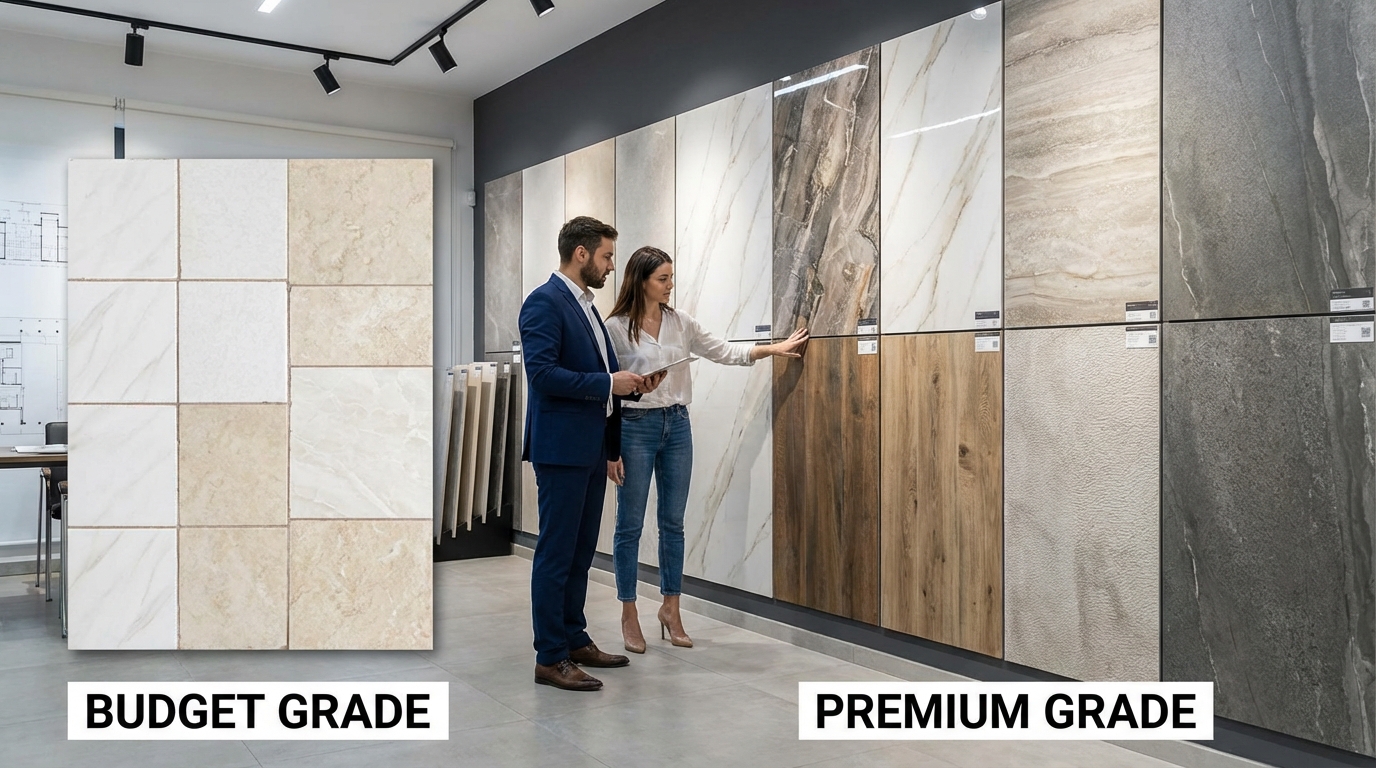
Two quotes can look identical on paper and use completely different materials. "60x60 floor tiles" could mean IDR 80,000 per square meter from a local factory or IDR 450,000 per square meter for imported porcelain. Both are "floor tiles." One will look tired in two years. The other won't.
The honest version of this: a firm quoting IDR 3 million per square meter is probably specifying basic-grade local materials. The firm at 6 million is likely using mid-range options with better durability. The firm at 11 million might be specifying imported finishes and custom fabrication.
None of these is inherently wrong. What matters is whether the materials match what your space actually needs. A back office that clients never see doesn't need premium stone flooring. A bank branch lobby that represents your brand to thousands of customers per week probably does.
The problem is when the proposal just says "floor tiles" without brand, grade, or specification. If a firm won't itemize materials, you can't compare their quote against anyone else's.
Project Management Depth

Basic firms assign a designer who also manages the project. They visit site once a week, maybe less. If a subcontractor installs something wrong on Tuesday and nobody checks until Friday, you've got four days of cascading problems.
Firms that charge more often have dedicated project managers who function like orchestra conductors, coordinating every trade, checking work daily, and catching problems when they're still cheap to fix. A misaligned partition wall caught on day one costs a few hours of labor to fix. Caught after the electrician has already run conduit through it? That's a week of rework.
This management layer typically adds 10-20% to project cost. On a straightforward office fit-out, you might not need it. On a complex project with 15+ specialist trades, structural modifications, and a tight deadline, skipping it is how projects go 40% over budget.
How Many Trades Are Involved
A simple office renovation might need five trades: demolition, carpentry, electrical, painting, flooring. A high-end commercial space can require 20 or more: custom millwork, acoustic specialists, decorative metalwork, glass partitioners, AV integrators, mechanical engineers, fire protection contractors.
Each additional trade multiplies coordination complexity. The millwork installer can't start until the electrician finishes rough-in. The painter can't work while the ceiling contractor is overhead. The flooring crew needs everyone else out of their way.
Budget firms often underestimate this coordination cost. Things get built out of sequence. The ceiling goes up, then someone realizes MEP cabling wasn't run first, so the ceiling comes back down. Premium firms price this coordination explicitly as a line item.
Jakarta Market Reality
What Things Actually Cost
For commercial office fit-outs in Greater Jakarta, here are realistic ranges based on current market conditions:
- Basic (functional, not impressive): Around IDR 3 million per square meter. Standard local materials, basic finishes, minimal custom work.
- Decent (presentable to clients): IDR 5-6 million per square meter. Better material quality, some design thought, proper finishing.
- Premium (people notice when they walk in): IDR 10-11 million per square meter. High-quality materials, custom elements, detailed finishing, strong design concept.
Location matters too. Central Jakarta projects typically run 10-15% higher than equivalent work in Tangerang or Bekasi, driven by stricter building management rules, limited work hours, and more complex logistics.
These numbers should be your baseline. If a quote falls dramatically below these ranges, ask what's excluded. If it's dramatically above, ask what justifies the premium.
Design Fees Separately
Design services typically range from IDR 20-50 million for a complete commercial project, depending on scope. Some firms charge per square meter (IDR 500,000-700,000/sqm for design and working drawings). Others charge hourly.
Firms that don't charge separately for design aren't giving it away free. They're burying it in the construction price, which means you can't evaluate whether their design process is thorough or an afterthought.
How to Actually Compare Quotes
Demand Specificity
"Complete electrical installation" tells you nothing. "Electrical rough-in including 40 LED downlights (Philips DN029B, 18W), 15 double power outlets (Panasonic), 8 data points (Cat6), panel upgrade, testing and certification" tells you the firm actually planned the work. You can price-check every item.
If a firm resists this level of detail, consider why. Firms that know their numbers are happy to show them.
Check the Exclusions
The cheapest quote often has the longest exclusions list. Permits, site cleaning, furniture installation, building management fees, after-hours work charges. These add up fast. A quote that's IDR 500,000/sqm cheaper but excludes five things the other quotes include isn't actually cheaper.
Match Specifications Before Comparing Price
Line up the material specs from each proposal side by side. Are they quoting the same grade of gypsum board? The same paint system (primer + two coats vs. single coat)? The same cable rating for electrical? Same thickness of glass for partitions?
Price differences on identical specs are meaningful. Price differences on different specs are just different products.
Ask About Change Orders
Every project has changes. Good firms provide written variation orders with pricing before any change work begins. Budget firms handle changes verbally and sort out the cost later, which is how you end up with surprise invoices at the end.
Want to understand what fair pricing looks like for your specific project? We'll walk you through the cost breakdown honestly, no vague line items, no hidden markups.
The Bottom Line
Price differences between interior design firms aren't arbitrary. They reflect real differences in material quality, management depth, experience level, and overhead structure.
The cheapest quote isn't a bargain if it leads to rework, delays, and a space that doesn't hold up. The most expensive quote isn't worth it if you're paying for brand prestige rather than project quality.
Get specific proposals. Compare specifications, not just totals. Ask hard questions about what's included. The firms worth hiring will welcome the scrutiny.