


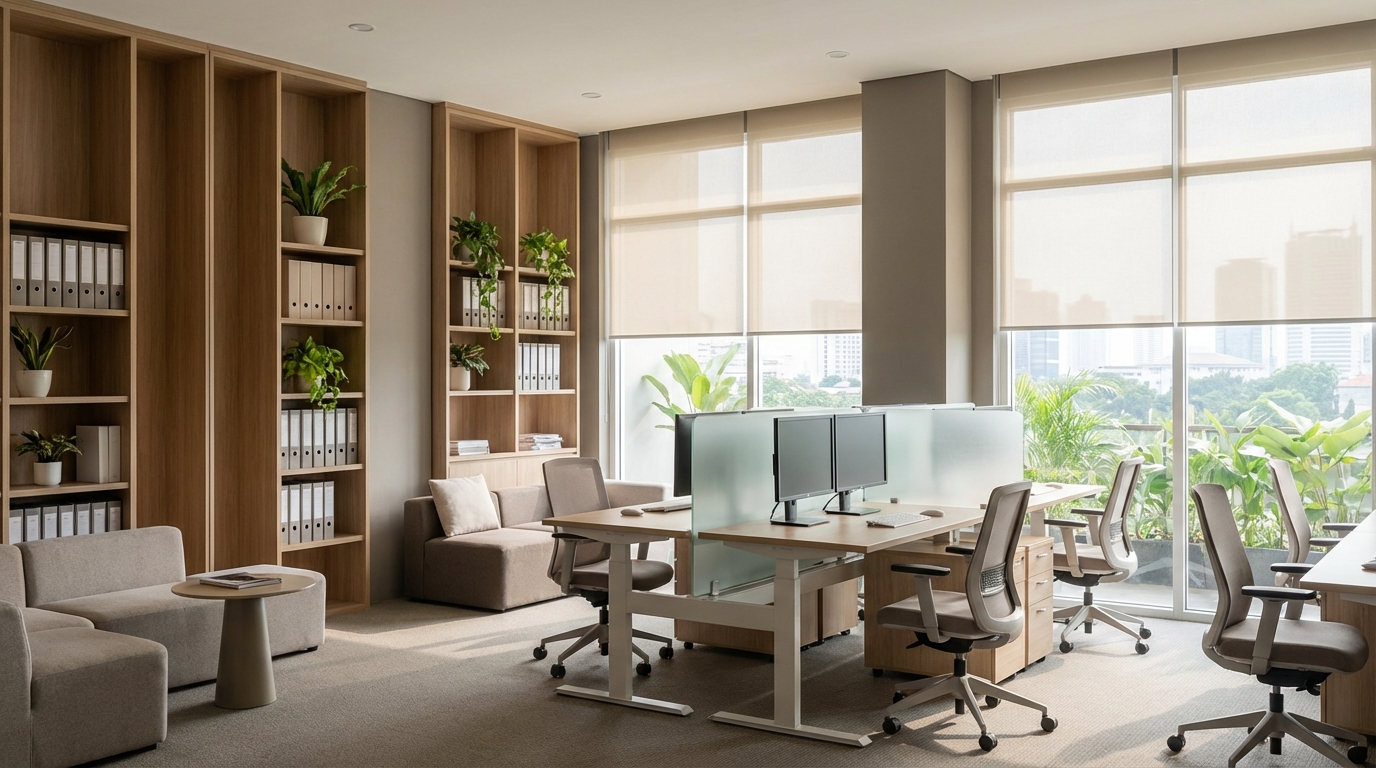
Most small offices in Jakarta fail because owners design for what looks good on Pinterest instead of what actually works in a 60 sqm space with 85% humidity and six people trying to take calls at the same time.
The problem isn't lack of space. It's lack of logic. A well-designed 50 sqm office outperforms a badly planned 150 sqm one every time. But that requires thinking about how people actually work, what materials survive Jakarta's climate, and whether your design can be built within your budget.
The Hidden Costs of Small Office Space in Jakarta
In Jakarta's prime business districts, office space runs IDR 400,000-550,000 per square meter per month. For a 100 sqm office, that's IDR 40-55 million monthly before you've bought a single desk.
Most offices waste 30-40% of their floor area on dead space. Hallways that are too wide. Meeting rooms sized for 12 people that get used twice a month. Every wasted square meter costs you IDR 4.8-6.6 million per year in rent alone.
Security deposits run 3-6 months of gross rent — IDR 120-330 million tied up before you move in. Then comes fit-out. Basic construction starts at IDR 2 million per square meter. A decent space runs IDR 5-6 million. Premium work hits IDR 10-11 million.
For a 100 sqm office, that's IDR 500-600 million for acceptable quality. (Learn more about why construction costs vary so much between firms.) Reducing your footprint from 100 sqm to 70 sqm saves you IDR 12-18 million per year in rent, IDR 90-180 million in security deposit, and IDR 150-180 million in fit-out costs. That's real money.
Jakarta's Climate Challenge: What Most Small Offices Get Wrong
The Humidity Problem
Jakarta's humidity runs 75-95% year-round. That moisture is eating your office whether you notice it or not.
SPC flooring became trendy recently. It looks good in showrooms. But the foam underlayer absorbs moisture in Indonesian humidity, causing the flooring to warp and curl within 18-24 months. You'll see it lifting up in retail outlets all over Jakarta now.
Timber elements need special attention. A European-style timber facade looks stunning in renders. In Jakarta's humidity, it rots and grows fungus within months. Same problem with solid wood desks without proper sealing.
Your office needs materials that can handle constant moisture. Sealed surfaces. Proper ventilation. Air circulation even when the AC is off.
Why That Glass Wall Is Killing Your AC Budget
Jakarta's commercial buildings love floor-to-ceiling glass. It looks modern. It also turns your office into a greenhouse.
Large unshaded glass walls create massive heat gain. Your air conditioning runs constantly trying to compensate. In hot, humid climates, 60% of building energy consumption goes to cooling. A poorly designed small office can easily spend IDR 5-8 million monthly on air conditioning alone.
Proper solar shading — exterior blinds, overhangs, or interior roller shades — reduces heat gain by 40-60%. That's the difference between tolerable electricity bills and watching your profit margin disappear.
Natural Ventilation Saves Money
Most Jakarta offices seal everything shut and run AC 24/7. It works, but it's expensive and often unnecessary.
Natural ventilation can handle cooling during early mornings and late afternoons when outdoor temperatures drop. Position windows and doors to create airflow paths. Use ceiling fans. Save the AC for brutal midday heat.
A well-designed small office should be able to operate comfortably on natural ventilation for 20-30% of business hours, reducing cooling costs significantly.
Strategic Space Planning: The Logic-First Approach
Micro-Zoning for Small Offices
The biggest mistake in small office design is treating it as one open room. That creates chaos. Everyone hears everyone. Focused work becomes impossible.
Micro-zoning divides your office into purpose-built areas using strategic furniture placement, partial dividers, and acoustic treatment.
A functional 60-70 sqm office needs at least three zones: a collaboration area for meetings near the entrance, a quiet zone for focused work with acoustic separation, and a utility zone for printers, coffee, and storage away from work areas.
The 10 sqm Per Employee Myth
Indonesian regulations suggest 10 sqm per employee. That's a guideline, not a law.
Space requirements depend on what work people actually do. Globally, office space per employee has dropped from 21 sqm in 2011 to around 18 sqm by 2020. That reflects changing work patterns — more mobile workers, hybrid schedules, shared desks.
For small offices in Jakarta, 7-10 sqm per person works if you design intelligently. The key question isn't "how much space per person?" It's "what activities happen here and what space do those activities need?"
Multi-Functional Spaces
Small offices can't afford dedicated single-purpose rooms. A meeting room that sits empty 80% of the time is wasted money.
Design spaces that transform based on need. A meeting table with power outlets serves as collaboration zone during morning sessions and individual workspace in the afternoon. A corner with comfortable seating and whiteboard works for client presentations and staff breaks.
Use modular furniture on casters that rearranges in minutes. But this only works if you plan for it — clear floor paths for moving furniture, storage for items that get rotated out, enough power outlets in multiple locations.
7 Space-Saving Design Ideas That Actually Work
1. Vertical Storage Solutions
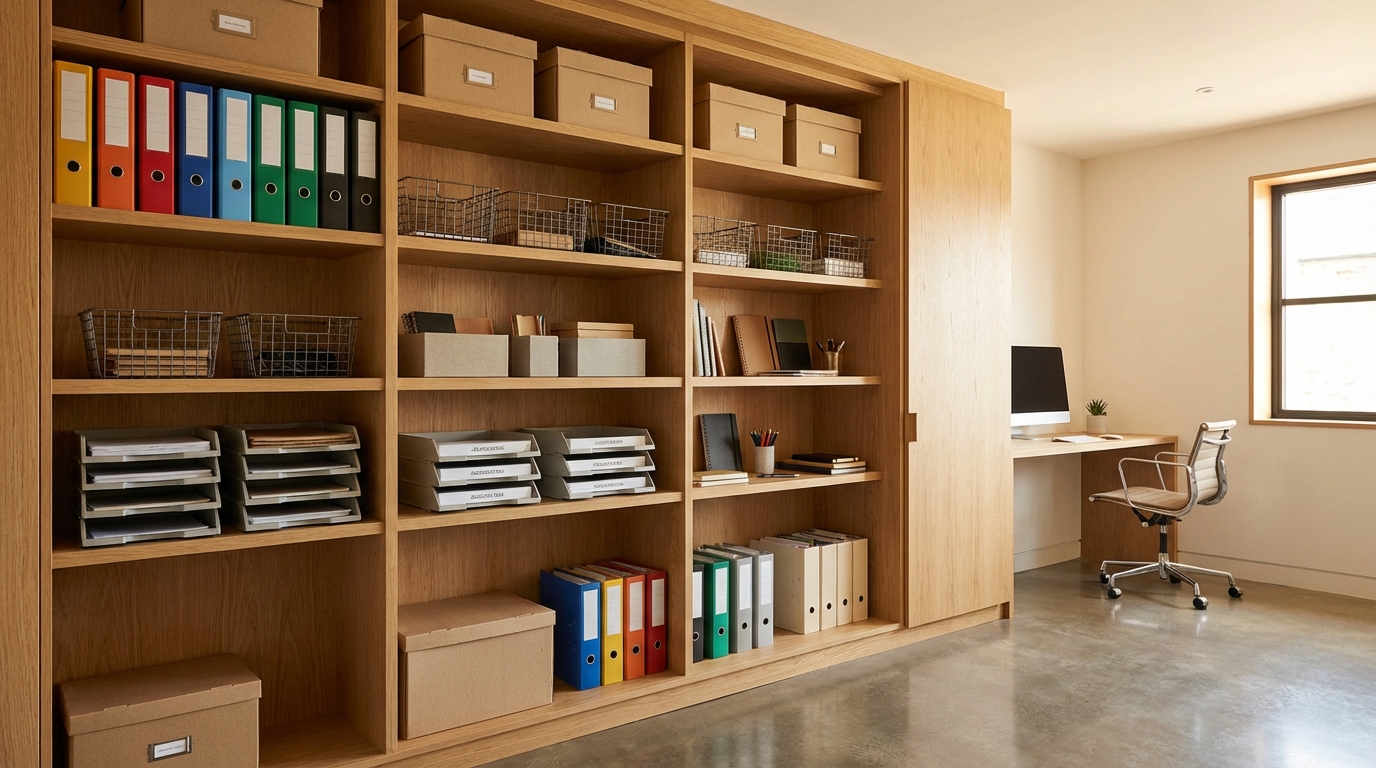
Floor space is expensive. Wall space is free. Use it.
Floor-to-ceiling built-in shelving maximizes storage without eating floor area. Custom shelving fitted to your walls wastes no space and looks cleaner than random furniture pieces.
Keep active files between 0.8-1.8 meters. Archive storage can go higher. Make sure your walls can support the weight — gypsum walls need proper reinforcement during construction.
2. Smart Furniture Choices
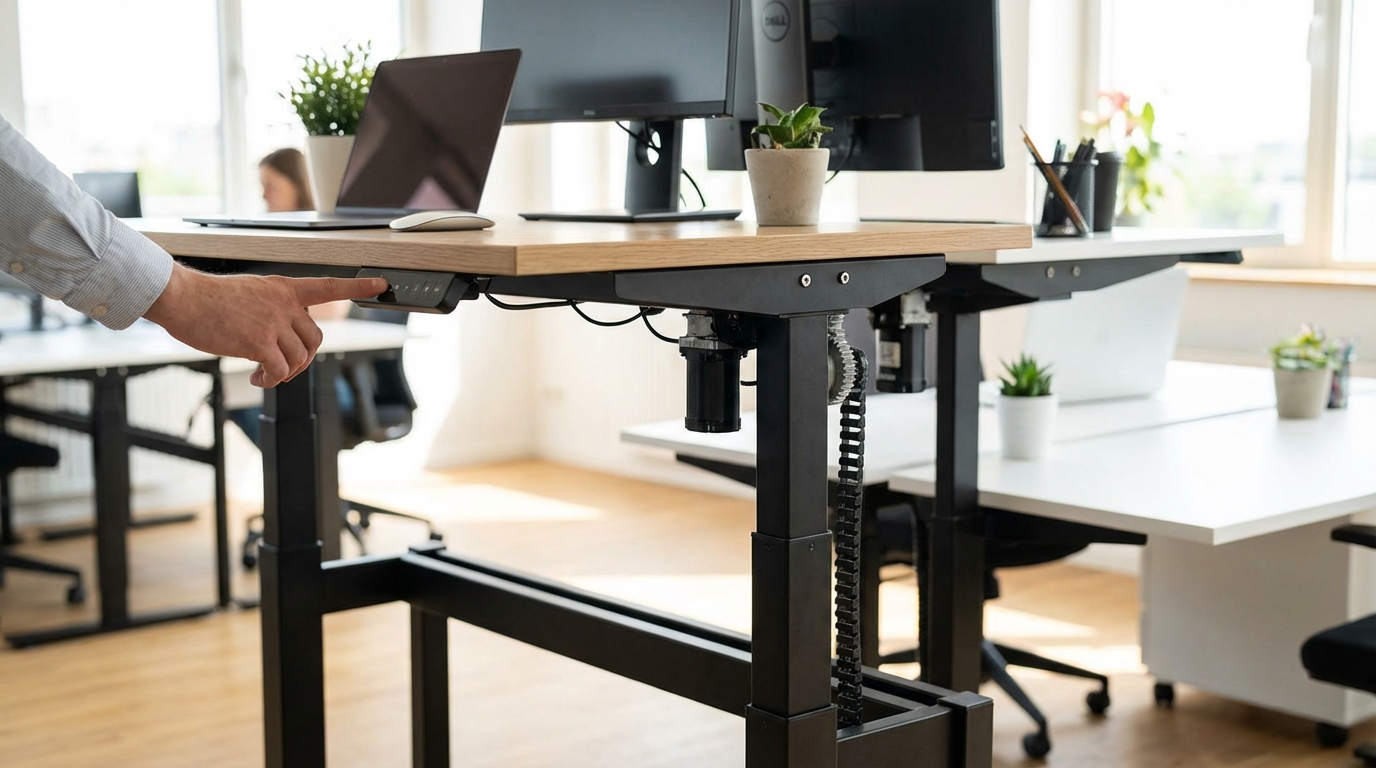
Massive executive desks are space killers. Compact corner desks, extendable tables, and slim workstations give people functional workspace without dominating the room.
Choose furniture with exposed legs rather than solid bases. When you can see under desks and chairs, the room feels larger.
Adjustable-height desks serve double duty — staff can sit or stand, and standing-height surfaces work for quick meetings. Mobile furniture on casters gives you flexibility you're not locked into.
3. Digital-First Document Management
Filing cabinets are space murderers. A typical four-drawer filing cabinet occupies 0.5 sqm and costs IDR 2.4 million per year in rent for physical documents.
Digitize everything you legally can. Scan invoices, contracts, project files. Businesses that go digital typically reclaim 10-20% of their office space. For a 70 sqm office, that's 7-14 sqm freed up — equivalent to adding another employee workspace.
4. Minimalist Design Principles
Every piece of furniture and equipment should justify its presence. Clean lines and uncluttered surfaces create visual spaciousness and make cleaning easier in humid climates where dust and mold accumulate fast.
Use light, neutral colors on walls and furniture. White, light gray, and beige make small spaces feel larger by reflecting more light.
5. Integrated Technology
Wireless charging pads built into desks eliminate cable clutter. Power outlets integrated into furniture reduce extension cords snaking across the floor.
Use cable trays underneath desks. Run power and data lines through walls during construction. The investment pays back in cleaner aesthetics and safer working conditions.
6. Acoustic Treatment
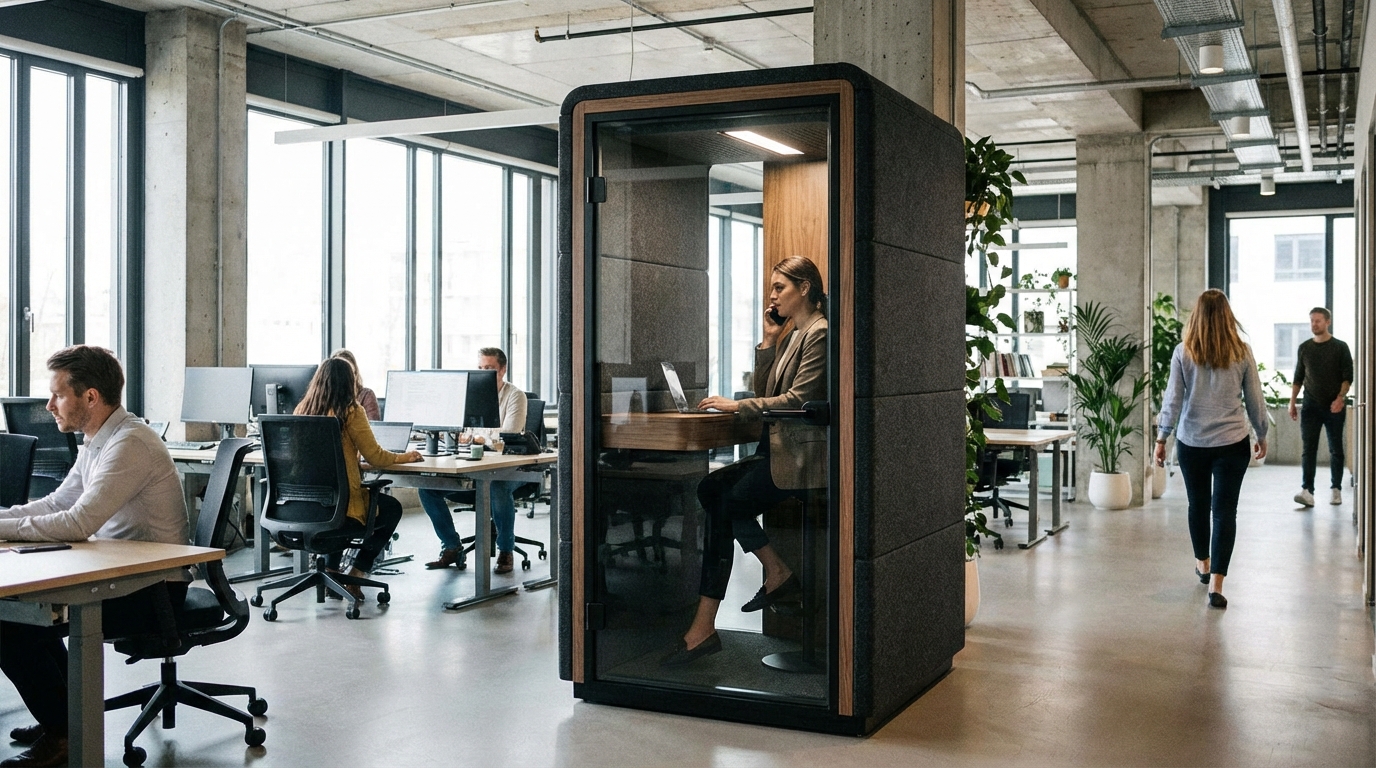
Poor acoustics ranks as the top workplace complaint. In small spaces, noise problems amplify because there's nowhere to escape.
Phone pods — 1 sqm booths with acoustic padding — give people quiet zones for calls. Huddle zones with sound-absorbing panels create semi-private areas for quick discussions.
Add acoustic panels or fabric-wrapped boards to walls and ceilings. In Jakarta's typical concrete and glass spaces, hard surfaces bounce sound everywhere without treatment.
7. Natural Light Optimization
Natural light makes small spaces feel larger and reduces electricity costs. But you need to control it properly.
Position workstations near windows but not directly facing them — direct sunlight on screens creates glare. Position desks perpendicular to windows so light comes from the side.
Use adjustable window treatments to control light levels throughout the day while maintaining brightness benefits.
Ready to design a small office that maximizes every square meter? Our team specializes in space-efficient commercial interiors built for Jakarta's climate and business realities. Let's discuss your project.
The Productivity ROI: Why Design Investment Pays Back
The average office worker is productive for fewer than 3 hours during an 8-hour workday. That's not laziness. It's environment.
Constant interruptions, uncomfortable furniture, poor lighting, and noise distractions destroy focus. Small office design directly impacts these factors.
Office workers get interrupted approximately every 3 minutes. Each interruption requires 23 minutes to regain full focus. In small cramped offices without proper zoning, interruptions are constant.
Better design minimizes this. Zoning keeps disruptive activities away from focus areas. Acoustic treatment reduces how far sound travels. Visual separation reduces distractions.
Specific design elements that improve productivity: Natural light (workers near windows report 15-20% higher job satisfaction), temperature control (productivity drops above 24-25°C), proper ergonomics (adjustable chairs and appropriate desk heights), and acoustic privacy.
These aren't luxuries. They're investments that pay back through improved output, reduced sick days, and lower staff turnover.
Implementation Checklist: From Concept to Reality
Before you commit to any design:
Verify building constraints. Service lift dimensions, floor load limits, work hour restrictions, building management rules. These shape what you can actually build.
Get accurate measurements. Don't trust developer drawings. Floor plans lie. Walls are rarely perfectly square.
Confirm material availability and cost. Beautiful renders are worthless if materials aren't available in Jakarta or blow your budget.
Plan for climate reality. Materials must handle 75-95% humidity year-round. Proper sealing and moisture-resistant materials aren't optional.
Budget for actual total cost. Rent plus security deposit plus fit-out plus furniture plus technology plus moving. Many business owners underfund fit-out and end up with half-finished spaces.
Include as-built drawings in your contract. You need documentation showing where electrical lines, plumbing, and structural elements are located for future modifications.
Demand detailed specifications. "Installation only" quotes exclude materials. "Light points" might not include bulbs or connectors. Force contractors to specify exactly what's included. (See red flags to watch for in design proposals.)
Conclusion
Small office design in Jakarta requires thinking about actual constraints before aesthetic preferences. Can materials handle the humidity? Does the layout work for how people actually do their jobs? Can you afford not just monthly rent but upfront fit-out costs?
Start with clear understanding of what work happens in your office and what conditions support that work. Then design space that enables it.
Done right, a well-designed 60 sqm office outperforms a poorly planned 150 sqm space. The difference is thinking through real operational needs instead of copying what looks good in design magazines.
Need expert guidance on your small office design project? With 700+ completed projects across Jakarta and Tangerang, we understand how to create productive workspaces that work within your budget and Jakarta's unique challenges.
Start your consultation on WhatsApp