


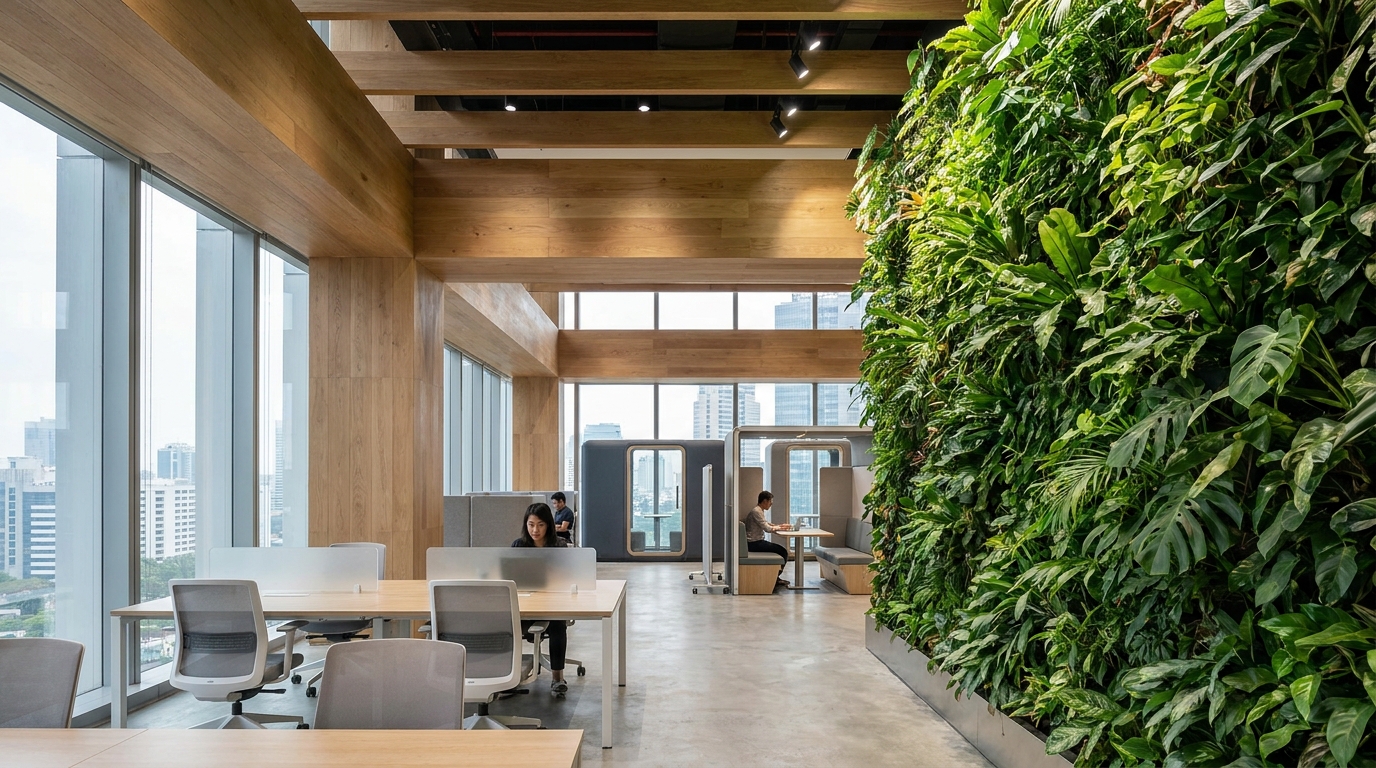
Every January a fresh batch of interior design trends shows up on Pinterest and in showrooms, and every year a few of them quietly destroy themselves in Jakarta's humidity. So before we talk about what's trending for 2026, one rule: a trend is only worth following if you can build it, source it within budget, and keep it working in this climate. The rest is just decoration that fails on schedule.
The commercial design trends 2026 brings to Indonesia are mostly sensible. Offices are getting smaller and more flexible. Spaces are getting warmer and more local. Sustainability stopped being a marketing line and became a real requirement. The question isn't whether these trends are good. It's whether your designer knows how to execute them without the usual mistakes.
Smaller offices, but planned harder
The biggest shift in Jakarta isn't a style. It's square meters. Hybrid work stuck around, and companies are rightsizing instead of renewing the same footprint.
The numbers back this up. Jakarta CBD office occupancy sat near 75% in early 2026 and is forecast to climb to around 76-77% by year-end. Demand is holding at roughly 100,000 to 150,000 sqm a year, but a lot of that is relocations and tenants taking less space than before. Companies are paying for the office they actually use, not the one that looks impressive on the lease.
That changes how you design. A 200 sqm office for a team that's only fully in three days a week needs different planning than a fixed-desk floor. You want reconfigurable zones, not permanent walls. Modular furniture that rearranges for a team session on Monday and quiet focus work on Thursday. Fewer dedicated single-use rooms.
The trap here is treating "flexible" as an excuse for one open room with no acoustic plan. That's not flexibility, that's chaos. If you're tightening your footprint, the planning matters more, not less, because every square meter has to earn its place.
Biophilic design that survives past month three
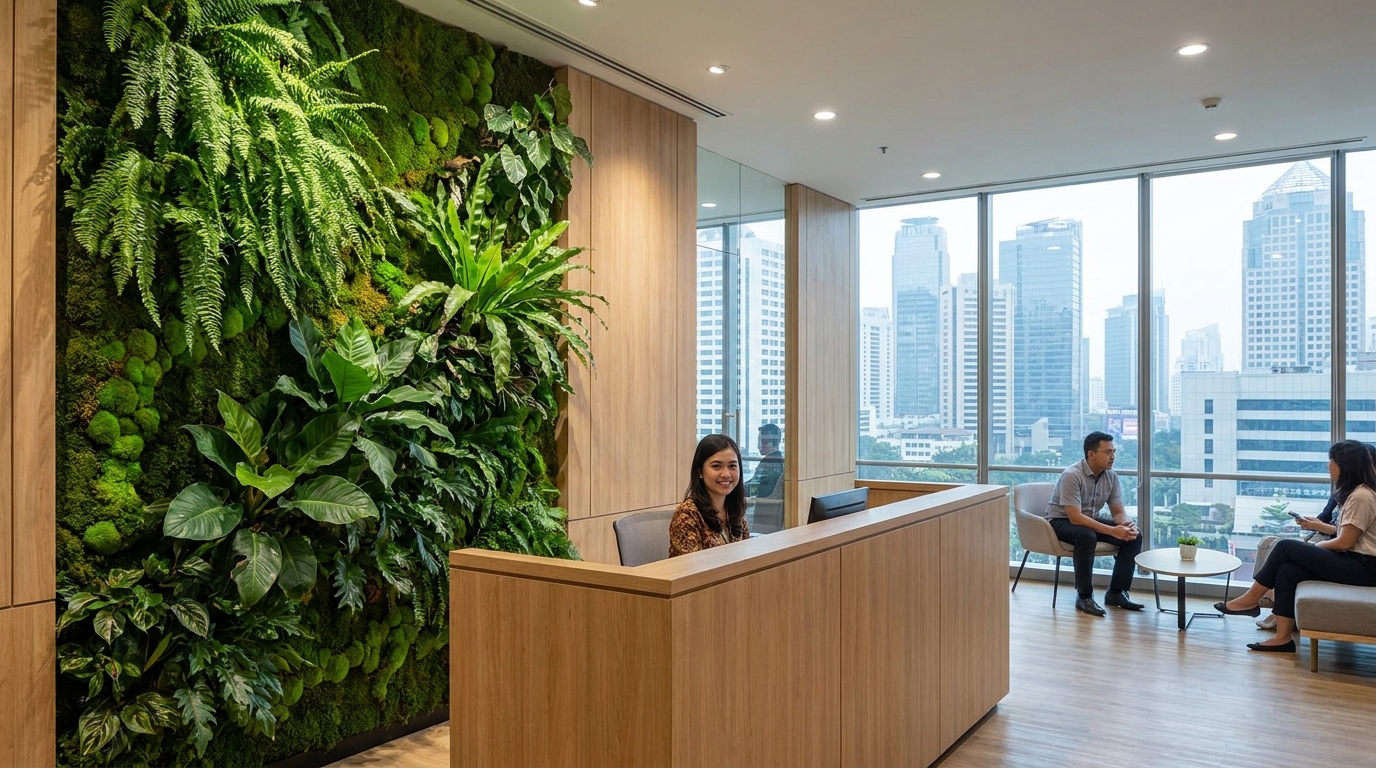
Biophilic design is the trend that refuses to leave, and for good reason. Plants, natural light, timber textures, green walls. In a city where a lot of buildings have genuinely bad indoor air, bringing nature inside isn't only aesthetic. It helps with air quality and how people feel at work.
The 2026 version is more ambitious. People want living systems built into the space, not a few pots near the window. Green walls, integrated planters, real daylight strategies.
Here's where logic has to step in. A vertical garden looks stunning in the render and becomes a maintenance nightmare if nobody planned for irrigation, drainage, or who waters it on a Sunday. Live plants need light, and a green wall in a dark corner just dies slowly. Before you commit to a feature wall of foliage, somebody has to answer the boring questions: how does it get water, how does it drain, and who maintains it after we hand over the keys.
Done properly, biophilic design is one of the few trends that pays you back. Done as decoration, it's a brown wall within six months.
Local materials and the warm, neutral look
Across offices, cafes, and retail, the palette for 2026 is warm and grounded. Coffee, cream, sand, beige, with darker natural accents. The cold all-white minimalist look is fading. So is loud industrial concrete everywhere.
Part of this is the Japandi influence that took over Jakarta's cafes and restaurants: clean lines, calm tones, natural materials, nothing shouting for attention. Part of it is a real return to Indonesian craft. Teak, rattan, woven textures, batik patterns, locally sourced stone. After years of imported European looks, local materials are back in commercial spaces, and they make sense here. They suit the climate, they're easier to source, and they actually mean something to your customers.
There's a budget reason too. Locally made furniture and Indonesian stone usually cost less than imported equivalents and arrive faster. When you specify a slab from a quarry a few hours away instead of one shipped from Italy, you cut cost and lead time without cutting quality.
One caution on the natural-material trend. Wood and rattan are beautiful and they're organic, which means they react to moisture. Untreated or poorly sealed timber in a humid Jakarta interior will swell, stain, and grow fungus. The look is right for 2026. The execution has to account for 75-95% humidity, or it ages badly.
Planning an office or F&B fit-out for 2026? Tell us your space, your budget, and your timeline, and we'll tell you honestly what works in Jakarta and what won't.
Sustainability is now the baseline, not the brochure
For years sustainability was a line in the proposal that nobody checked. That's changing. Corporate ESG commitments and tenant expectations have made it a real requirement, especially for the multinationals and Grade A tenants driving Jakarta's market.
In practice this means a few concrete things. Reusing what's already on site instead of demolishing everything. Choosing materials with longer lifespans so you're not refitting in three years. LED lighting and better controls because energy cost is the part of the bill that never stops. Furniture you can reconfigure and reuse when the team changes shape again.
The honest version of sustainability is unglamorous. It's specifying a floor that lasts ten years instead of one that looks trendy and gets ripped out in two. A design built to be modified later, with proper as-built drawings so the next renovation doesn't start with guesswork, is more sustainable than any bamboo feature wall.
The trends to be careful with
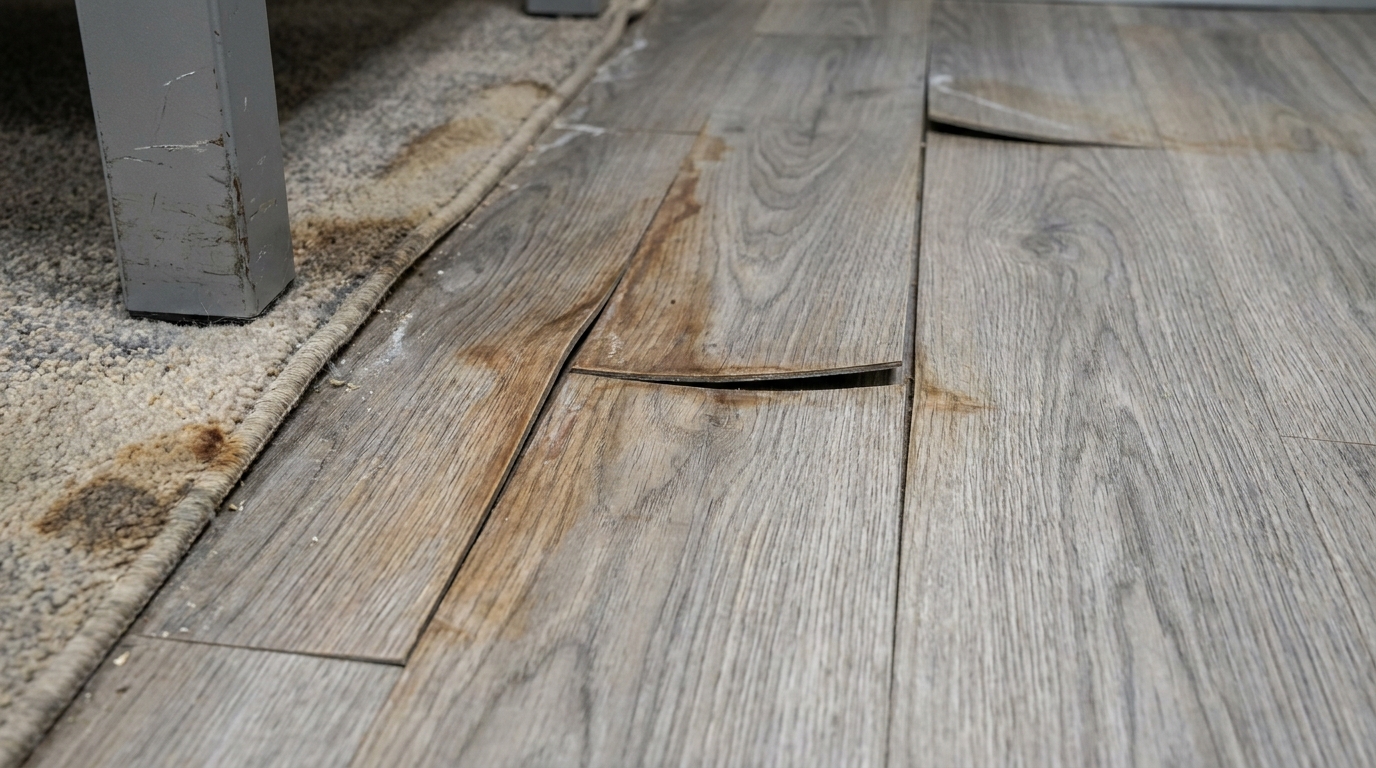
Not every popular material belongs in a Jakarta commercial space. A few keep getting specified because they look good in a catalog, and a few keep failing.
SPC flooring is the clearest example. The herringbone patterns and stone-like finish made it popular fast. But the foam underlayer absorbs moisture in Indonesian humidity, and the planks warp, curl, and lift, often within two years. You can see it peeling up in retail outlets across the city. SPC has its uses, but it gets sold as a do-everything floor when it simply can't handle the conditions here.
European-style timber facades are the other one. They photograph beautifully and rot quickly. Exterior timber in this climate grows fungus and degrades within months unless it's the right species, properly treated and detailed for drainage. A design that works in Holland doesn't automatically work in Tangerang.
This is the whole point of design logic. New isn't the problem. The problem is specifying something that can't survive what we already know about this market. A good firm tells you no before the floor lifts, not after.
What to actually do with all this
Trends are useful as a starting point, not a shopping list. The warm palette, the local materials, the flexible layouts, the real biophilic features are all genuinely good directions for 2026. The difference between a space that still looks good in 2029 and one that's already tired comes down to execution.
Set a realistic budget before you fall in love with a look. As a rough guide for Jakarta, basic commercial fit-out runs around 3 million IDR per sqm, acceptable quality sits around 5-6 million, and premium work reaches roughly 11 million. The trend doesn't change the math. A trendy material on a basic budget usually means a cheaper substitute that fails faster.
Then ask your designer the only questions that matter. Can it be built in my space? Can the materials be sourced within my budget? Will it still work, and still look right, two years from now? If they can answer those clearly, follow the trend. If they can't, that's your answer.
Want a 2026 design that holds up past the photoshoot? With 700+ completed commercial projects across Jakarta and Tangerang, we design for how the space actually gets used and how it survives the climate.